
May 12th 2026
How OSHA Labels Improve Workplace Safety and Compliance Tips
Workplace safety often depends on small details that people see every day but stop noticing after a while. A missing warning, a faded pipe marker, or a hard-to-read chemical label can create confusion at the worst time. That is where clear visual communication matters.
OSHA Labels help workers identify hazards, follow directions, and move through tasks with less risk and more confidence. When facilities use strong labeling systems and keep them updated, they create a workplace that feels more controlled, more organized, and easier to manage.
Why Clear Safety Labels Matter in Daily Work
A busy workplace moves fast. Machines run, materials shift, people travel across work zones, and tasks overlap throughout the day. In that kind of setting, workers need clear signs and labels they can understand at a glance.
Safety labels support that need in a practical way. They help people:
- Spot hazards before contact happens
- Follow the handling instructions with less confusion
- Identify storage areas, pipes, and equipment faster
- Reduce mistakes during routine and urgent tasks
- Support safer movement through shared work areas
This is not only about rules on paper. It is about helping people make better decisions in real time. A strong label system can lower guesswork, and that can lower risk.
How OSHA Labels Support Safer Decisions
When people can quickly read and understand a label, they respond faster and with more care. That matters in places where chemicals, electrical systems, hot surfaces, moving parts, or restricted zones are part of the workday.
OSHA Labels help turn safety instructions into something visible and direct. They can remind workers about personal protective equipment, show hazard levels, mark control panels, identify shutoff points, and label storage areas in a consistent way.
That consistency helps in several ways:
- New employees learn the site faster
- Experienced staff waste less time asking questions
- Contractors understand local hazards more quickly
- Inspections become easier to manage
- Teams build stronger habits around safety
Good labels do not replace training, but they support it every single day.
Common Areas Where Labeling Makes a Big Difference
Many facilities already know they need safety labels, but they often miss the number of areas where clear marking can help. Labeling is most useful when it is applied across the workplace instead of only in one department.
Some of the most important use areas include:
- Chemical containers and secondary containers
- Pipe marking and flow direction identification
- Electrical panels and arc-flash warning points
- Warehouse aisles, pallet zones, and traffic lanes
- Machine controls and lockout points
- Storage shelves and maintenance areas
- Wire wraps and cable identification
When these areas are marked well, the site becomes easier to read. That can improve both safety and workflow without making the environment feel cluttered.
What Good Safety Labels Need to Do
Not every label performs well in a real industrial setting. A label may look fine on day one and fail after heat, moisture, abrasion, or chemical exposure. That is why durability matters just as much as wording.
A good label should be:
- Easy to read from the needed distance
- Made for the surface and environment
- Resistant to fading, peeling, and wear
- Placed where workers can see it naturally
- Consistent in format across the site
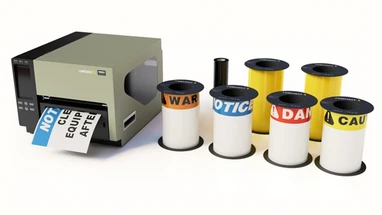
This is where in-house printing can help. LabelMax offers industrial printers, supplies, and label design tools that help facilities create labels as needed instead of waiting for outside orders. That can help teams respond faster when layouts change, equipment moves, or new hazards need marking.
Why Durability Matters in Hard-Use Environments
A label only helps when it stays readable. In safety-focused industries, labels often face rough conditions that can damage weak materials very quickly. Heat, cold, sunlight, chemicals, grease, moisture, and constant contact all test the strength of a printed label.
That is why materials should match the job. LabelMax offers supplies designed for industrial use, including:
- Indoor and outdoor vinyl
- Reflective and magnetic materials
- High-tack and temperature-resistant tapes
- Heat-shrink sleeves
- Self-laminating wire wraps
- Chemical-resistant X-Vinyl
- Multi-color thermal-transfer ribbons
For many teams, this matters because replacement time is also a cost. A label that lasts longer reduces repeat work and keeps safety communication visible.
Floor Marking Also Supports Safer Movement
Safety is not only on walls, pipes, and equipment. It is also underfoot. Floor marking helps define where people should walk, where pallets should sit, and where equipment should not block access.
This makes a difference in places such as warehouses, production floors, and service areas where traffic patterns change through the day.
Useful floor marking can help:
- Separate pedestrian and vehicle routes
- Mark staging and storage zones
- Support 5S and lean systems
- Reduce clutter in shared spaces
- Show boundaries around hazard areas
LabelMax includes heavy-duty floor tape options for aisles, pallet zones, and traffic lanes. When floor marking is clear, movement becomes smoother, and the site often feels more ordered.
Practical Tips for Better Label Compliance
A labeling program works best when it is reviewed like any other safety system. Labels should not be added once and then forgotten. They need regular checks, updates, and a clear standard for use.
Here are some practical tips:
- Review labels during routine safety walks
- Replace faded or damaged labels fast
- Use the same format across similar hazards
- Place labels where people already look during tasks
- Keep extra supplies ready for quick updates
- Train teams on what label colors and messages mean
- Include floor marking in the same review process
These steps are simple, but they build consistency. That is often the difference between a label program that exists and one that actually helps people.
Final Words
A strong safety culture is built through repetition, clarity, and follow-through. Training matters. Supervision matters. Procedures matter. But visual communication also matters because it is present in the moment when choices are made.
OSHA Labels support that daily layer of protection. They remind people what matters, where hazards exist, and how to act with care. When labels are durable, readable, and placed with purpose, they become part of how the workplace speaks to the people inside it. LabelMax helps facilities build that system with tools that support faster updates, better control, and a safer, more organized environment that people can trust every day.